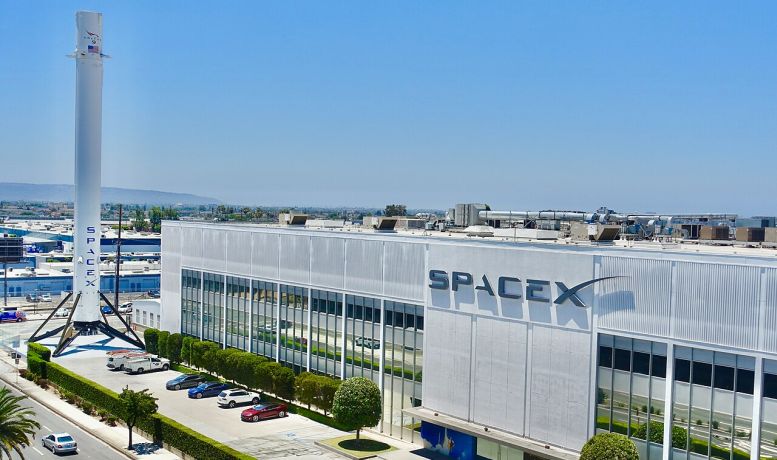
While workers pay through the nose for shortages stemming from Trump’s war on Iran, his billionaire friends are gambling trillions on the AI bubble. Elon Musk’s SpaceX has outraced Anthropic and OpenAI to be the first AI giant on the stock market, in the largest initial public offering (IPO) in history. Musk had restructured SpaceX to be an AI company by absorbing his startup xAI, which now accounts for 71 percent of the company’s value. Yet just a few days later, SpaceX stock had fallen below its debut price. It’s clear that AI IPOs only add more risk and volatility to a fragile economy, with no benefits for working people.
What Is An IPO?
An IPO is when a private company gets listed on the public stock market. This is a way for a corporation to raise cash through selling a part of its ownership. The IPO is a multi-step sale: in private, elite investors buy all the shares offered by a company, which gives the company a ton of cash. Then these elite investors do what they call a “roadshow,” hyping up the stock and arranging pre-sales. On the day of the IPO, the investors resell the shares to the general public at a stage-managed markup price.
In its IPO, SpaceX offered only 4 percent of its shares to the public. Musk engineered a Wall Street bidding war over this public chunk, driving its price up to $75 billion. The financial system then projected that if the public 4 percent is worth $75 billion, then the private 96 percent is worth $1.7 trillion, making Musk the world’s first trillionaire on paper for two fleeting weeks. This paper valuation is like a credit score for billionaires, meaning Musk’s companies can get cheaper loans because they’re “worth” so much now. Much of the financial world works off of shams like this, leveraging paper valuations for further speculation.
Billionaires Gamble, Workers Lose
AI stocks are especially unstable because the AI giants are hugely unprofitable. They spend enormous sums on new data centers and AI models while selling their products for cheap or even free. xAI lost $6.4 billion last year on a revenue of $3.2 billion. OpenAI lost $21 billion against $13 billion in revenue. Anthropic eked out a paper profit of $600 million in the second quarter of 2026, by masking its true data center costs for two months right before its planned IPO.
These IPOs are marketed as opportunities to let ordinary people in on the AI boom. But they are really schemes by the rich to pull public money into the AI bubble so they can sell their shares at a high price before the bubble pops—something top traders and CEOs are well aware is going to happen.
Financial companies are forcing workers’ retirement plans to buy SpaceX stock. SpaceX was inducted into many stock indexes, meaning it is now included in a bundle of stocks that pensions and 401(k)s automatically buy every day. Soon, Anthropic and OpenAI will also be in this bundle. In this system, when workers save for retirement, our money will automatically invest in AI stocks, driving up their price and making retirement funds look like they’re growing. But when there’s an AI stock crash, our retirement savings will get wiped out.
Invest In Our Needs, Not Markets
With trillions of dollars chasing after unprofitable AI stocks, the AI bubble threatens to destabilize the economy. Working people will bear the brunt of a market crash while the rich get out early or get bailouts. Already, the cost of living is soaring for most of us while the ruling elite pour real resources into AI speculation. This is how capitalism works—a blind quest for profit over human need. We need a struggle to tax the rich, invest in affordable housing, fund free college tuition, fund universal healthcare, and ultimately replace the incompetent, gambling ruling class with the rule of ordinary working people.