Anna Barret is a member of Socialist Alternative in the US
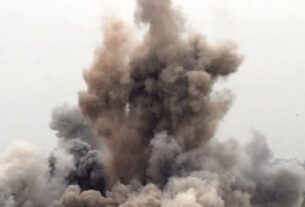
After five weeks of all-out war on Iran and seven weeks of a very fragile ceasefire, yet another round of talks is taking place between the US and Iran. Whether the result is a deal or a new round of war (or yet more limbo) is still an open question. On the morning of Tuesday, May 26, following several days of speculation—fueled by Trump more than anyone—that a deal was imminent, US warplanes carried out “defensive” (sic!) bombings in Iran and Israeli jets stepped up murderous assaults on Lebanon.
Even if a deal does pan out, it will likely be linked to an agreement to continue further negotiations, which are bound to be fraught with complications.
What is certain, however, is that the world has changed through the course of this war, and that lasting stability in the Middle East or globally is not in the cards. The war on Iran has opened up a new phase of difficulties for the Trump regime and further undermined US imperialism on the world stage. It has also deepened the trends toward increased war and militarism globally. Even if the war ends soon, its impacts, including the global energy shock and food crisis, will continue to radiate across every corner of the world.
Will There Be a Deal?
On the back of failed talks in April, Trump’s proclamation of an open-ended ceasefire and a US blockade of the Strait of Hormuz delivered very little aside from a heightened standoff over control of the Strait. This has continued to plunge the world economy into chaos. Warnings of an approaching “tipping point” or “red zone” for the energy industry loom.
These factors, along with the sheer unpopularity of this war, have ratcheted up pressure on Trump to try to reach some sort of “diplomatic” solution in a hurry. He skipped his son’s wedding and JD Vance was rushed back to Washington. Indicating his desperation to escape the war he started, Trump reportedly made calls to officials in Saudi Arabia, the UAE, Qatar, Pakistan, Turkey, Egypt, Jordan, Bahrain, and Israel. But the deal appears to be in serious trouble before it has even come into existence.
If talks fail, the prospect of a return to full-scale war on Iran is not ruled out, exemplified by Trump’s ever-frequent threats of annihilation as well as the amassing of a record 50 US military refuelling tanker aircraft at Ben Gurion airport in Israel. However, despite the complications of reaching a deal, escalation is not a particularly attractive option for Trump either, especially when there is far from any guarantee that military actions will be any more successful than the colossal five-week US/Israeli air campaign which failed to achieve a single stated objective. Despite Trump’s chest-thumping and the propaganda about US military might, reports have now revealed that 30 of 33 of Iran’s missile sites along the Strait of Hormuz remain functional. The predictions of total collapse or “explosion” of Iranian oil production have also not materialized. Up to this point at least, the Iranian regime has managed to endure the pain inflicted by the US and its allies and retains the upper hand.
At the time of writing, there are reports that an agreement would be based on a reopening of the Strait of Hormuz in exchange for the unfreezing of Iranian assets and lifting of sanctions. According to US sources, this is paired with an agreement from Iran to get rid of its highly enriched uranium stores, with details to be ironed out in the next 60 days. This is apparently denied by the Iranian side who have, in general, downplayed the imminence of an agreement.
After so many rounds of talks and at least $25 billion spent on the war, the fact that these terms are at best essentially a return to the pre-war status quo exposes how weak the US position is.
Global Impacts
The war has upended world politics and alliances in a way that cannot simply be reversed. Heads of state in Germany, Italy, Spain, and others, are further publicly distancing themselves from Trump and the US’s war. One key question will be the impact of any deal on Israel’s devastating war on Lebanon. Netanyahu, seemingly iced out of direct negotiations, intends to “enhance the blows” and “intensify the force” against Hezbollah. For the Lebanese people, the so-called ceasefire has not stopped the onslaught of Israeli forces, with rising civilian casualties and attacks on hospitals, ambulances, and medical personnel, which have only escalated as the US-Iran talks were underway.
This comes at a time when Israel is arguably more isolated than ever on the world stage. Its attacks on the Global Sumud Flotilla and the mocking of the abuse and violence against the flotilla activists by Israeli Security Minister Ben Gvir have provoked outrage internationally. This has pressured a number of governments to condemn these attacks, and the French government to ban Ben Gvir from entering their country. Even in the US, there is a sharp drop in support for the Israeli government among both Democratic and Republican voters.
The genocidal aggression against the Palestinian people also continues. According to the World Food Program, 1.6 million people, or 77% of Gaza’s population, are facing severe levels of acute food insecurity. The Israeli state has stepped up attacks and expanded military control to 60% of Gaza, and Trump’s farcical “peace” plan has only led to escalated suffering for the Palestinians. In the West Bank, settler violence is reaching a fever pitch.
Trump has also made the request (met with awkward silence) that allies in the region sign onto the Abraham Accords, normalizing relations with Israel, as part of any deal to end the war. This would be hugely provocative to the masses of those countries—who feel overwhelming solidarity with the Palestinian people—and extremely politically risky for these autocratic regimes. Iran has bombarded the Gulf states, deepening tensions between Saudi Arabia and the UAE, and shattering the illusion that these states were stable havens. These regimes want to avoid a further emboldened Iran.
The recent meeting between Trump and Xi Jinping also took place in the shadow of the Iran war, which Trump had hoped would be over by the time of this meeting. With this deepening crisis hanging around his neck, he showed up in a relatively weakened position. The US hoped to enlist China in pressuring Iran to negotiate, but the meeting produced no concrete commitments on the war. While the summit has been framed as a detente between the two rivals, this is only a product of the weak positions of both sides. The US-China inter-imperialist rivalry is in no way defused.
Trump’s Mess at Home
The Trump regime is also facing deepening problems domestically. Approval ratings for Trump’s second term have hit a record low, with particular frustration bubbling around the economic fallout of the war. While Trump still has a tight hold on the party, exemplified by recent primary election victories for Trump loyalists, noticeable cracks are opening up even within the hardened Trump base.
Deeper divisions have opened up in the Republican Party, especially over the war in Iran. Yet another vote on the War Powers Resolution, which would require congressional approval for the Iran war, was scheduled, but then hastily canceled after it became clear that the Republicans didn’t have enough votes to defeat it after defections from four Republicans. On the other side, Trump is under fire from more hawkish Republicans like Ted Cruz and Lindsey Graham over the prospect of an Iran deal.
Will a Deal Mean a Return to Normal?
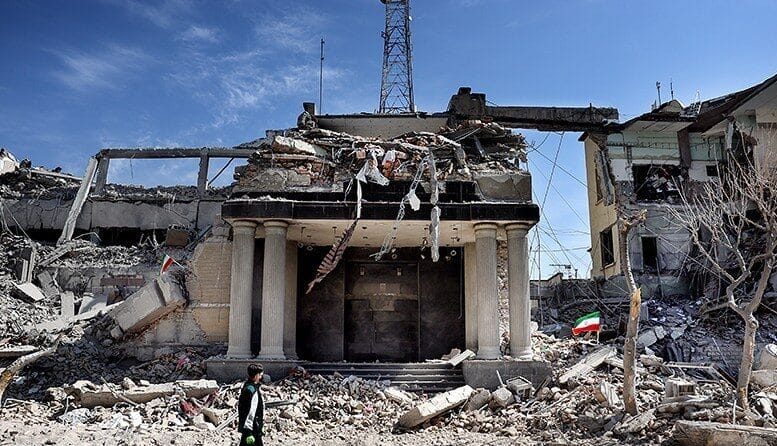
The prospect of any real return to “normal” is a pipe dream. The destruction left behind in the Middle East, in particular of human life and infrastructure in Lebanon and Iran, will be felt for decades to come. The US-Israeli war has killed at least 3,186 in Iran, 3,185 in Lebanon, and millions of people have been displaced.
The war has caused damage to energy infrastructure which will take years to repair. There is a shortfall of an estimated 10-12 million barrels of oil per day, OPEC’s oil production has dropped by nearly 30%, and it is expected to take months to return to pre-war levels. Restarting this will not be as simple as turning the tap back on, and prices will not drop dramatically in the short term.
Re-opening the Strait itself is also not purely a question of whether there is a formal ceasefire. Analysts predict that a return to previous transit capacity for tankers in the Strait could take around three months. Mines that were laid will need to be removed, and the estimated 1,500-2,000 ships with 20,000 seafarers aboard who remain trapped in the Strait will have to be navigated out. Because these ships were sitting still in the warm Persian Gulf water for so long, many are now covered with barnacles, algae, and jellyfish, which will make it harder and more costly to eventually exit the strait.
Even if Iran agrees to a full, unobstructed resumption of traffic with no fees (which they have already voiced opposition to), the Iranian regime has proved it is in control of the passage, raising the prospect of future blockades and introducing serious uncertainty for the shipping industry. Shipping traffic in the Bab el-Mandeb Strait in the Red Sea has still not returned to the levels from before the 2023 Houthi attacks.
And it’s not just the Strait that’s complicated. The economic impacts of the war cannot easily be resolved. The shock in the energy industry and shortages of crucial items such as helium will radiate out to manufacturing and continue to push the price of goods up. The shortage of fertilizer impacts farming and food prices. Inflation, paired with slow or no growth in the economy, raises the prospect of stagflation. Even if the war ends tomorrow, the damage to the world economy can’t just be wiped away.
We Won’t Pay for Your Wars
This war has been a disaster and an embarrassment for US imperialism. But while Trump is desperately searching for an off-ramp from Iran, the US imperialist war machine will not just take their ball and go home. They will continue to ramp up their campaign of militarism and prepare for future conflicts.
Those who have positioned themselves as an opposition to Trump—for example, the corporate Democratic Party and some NATO powers—will also double down on a militarist agenda, despite wrapping it up in rhetoric about defense. The islamist dictatorship in Iran, which brutalized its own protesters earlier this year, offers no alternative for workers and the oppressed. Chinese imperialism, while it may try to paint itself as the friendlier, more diplomatic power in the inter-imperialist conflict, has been watching closely and will continue to pursue its own imperialist interests.
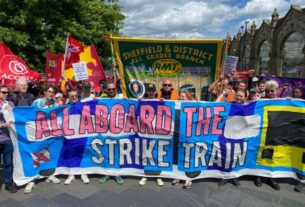
Working-class and poor people are bearing the brunt of this war and its economic impacts. The neo-colonial world has been particularly hard hit. Strikes and protests emerged in the Philippines, and India, and then recently in Kenya, Mozambique, and Comoros as well as in Ireland, with transport strikes and mass protests. Workers and the poor around the world have common interests against the warmongers who are driving the world into crisis. There is an urgent need for mass, international struggle against war and militarism, linked to the fight against the cost of living crisis.
We Say:
- No to imperialist war! For mass working- class action to stop US-Israeli attacks on Iran and Lebanon.
- End the occupation of Gaza and dismantle all Israeli settlements in the West Bank. End the blockade and organize urgent humanitarian aid to stop the crisis in Gaza.
- Price controls and debt forgiveness for working and poor people to address the energy crisis. Nationalize the energy industry under democratic workers’ control.
- For an internationally coordinated, genuine green transition with a massive green jobs program that defends the wages, benefits, and union representation of workers in polluting industries.
- Money for jobs, education, housing, healthcare, and social services, not military budgets.
- Build an organized working-class struggle in Iran against the right-wing, islamist dictatorship, with appeals for common struggle to workers across the region.
- Step up the anti-Trump struggle in the United States: build mass workers’ action against the attacks on working people in the US and globally.
- Build movements against all imperialism. For anti-war, working-class political parties in every country to push back the far right and the billionaires.
- For revolutionary socialist struggle against capitalism! End the dictatorship of the bosses and fight for a socialist world free from war, oppression, and exploitation.