Tom Costello is a member of Socialist Alternative in England, Wales and Scotland
The devastation caused by US imperialism’s war on Iran has been widely documented. The independent Iranian Human Rights Activists News Agency estimates that as many as 3,636 have been killed there, and in Lebanon, the death toll from the Israeli regime’s ongoing assault has also exceeded 3,000.
Besides the immediate loss of life, the war is having an enormous impact on the living standards of millions of poor and working-class people across the world. With the ongoing closure of the Strait of Hormuz, an historic energy crisis is under way, which is still far from reaching its peak. The IMF has issued warnings that, without an end to the conflict, it is quite possible that a new stagflationary recession is on the cards – a scenario in which it would be the working class forced to bear the brunt.
Another consequence of Trump’s war, one which has gotten far less media attention, has been its devastating environmental impact, at a time of already-deepening climate crisis. This is a war not only against the Iranian and Lebanese people, but also against the planet. While workers face instability and the planet burns, major fossil fuel companies have actually benefited from the crisis – raking in record profits.
A War on People and Nature
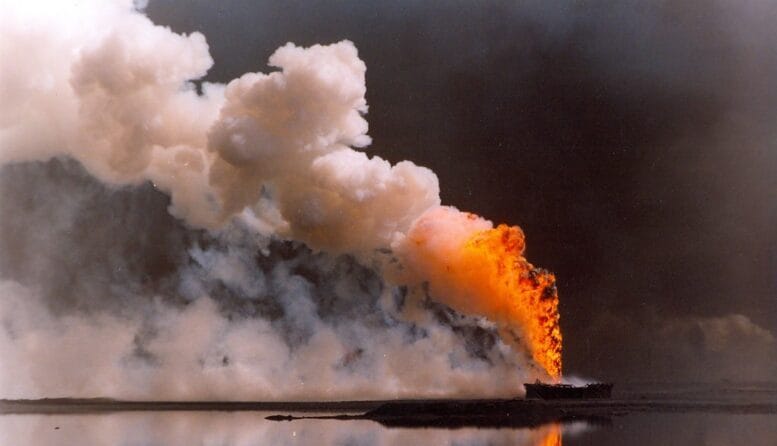
After the first bombs landed on Iran in March, the media was flooded with images of Tehran on fire. This was in the wake of Israeli military attacks on four major oil depots on the outskirts of the city, which left millions of barrels of oil in flames. Iranians woke up to find the whole city shrouded in black dust, the air thick with CO2 and methane, and the sky glowing orange. The level of air pollution was so high that “black rain” fell in Tehran.
But this is only the tip of the iceberg when it comes to the environmental impact of the bombings. Researchers at Queen Mary, University of London found more than five million tonnes of CO2 were released into the atmosphere during just two weeks of the conflict – equivalent to the total level of carbon released by Iceland in a whole year, and equal to the combined emissions of the world’s 84 lowest-emitting countries.
Part of this is driven by the enormous fuel consumption required for the deployment of missiles towards and from US military bases in the surrounding region. The Guardian reported that between 150 million and 270 million litres of fuel were burnt in the first 14 days of the war alone.
These figures show how imperialism and militarism threaten not only human life, but also the environmental conditions needed to sustain it. The pollution of water networks, destruction of critical infrastructure, and contamination of soil and water sources will endanger the livelihoods and health of future generations across the region.
There have also been multiple reports of oil spills in the Persian Gulf since the start of the war, with oil washing up on islands that are protected wildlife refuges. The continuing threat of oil spills in the Gulf, caused by the disruption and militarisation of supply routes, will have devastating consequences extending far beyond the war itself. The continued destruction of marine ecosystems (mangroves, coral reefs etc.) would in turn have severe knock-on effects for food security and coastal flood protection, further accelerating the region’s refugee crisis. This danger is compounded further by the growing number of extreme weather events, which saw military deployments in disaster responses more than 160 times globally over just six months in 2025.
Mega-Profits for Big Oil
While workers weigh up the choice between filling up their gas tanks or putting food on the table, for the fossil fuel industry, this war has been enormously lucrative. The squeeze on the oil supply has ramped up fuel costs – and therefore profits. The EU’s fuel bill has risen by 22 billion euros since the start of the war. In Malawi, one of the poorest countries in the world, the prices of gas and diesel have risen more than 140% over the past year, making it the second most expensive country for fuel globally.
Meanwhile, according to The Guardian, the top 100 oil and gas companies internationally gained $30 million every hour in windfall profits over the first month of the war. BP boasted about “exceptional oil trading” after reporting a doubling of first quarter profits compared to 2025. Some countries, such as Australia, have tried to offset the rising costs for consumers by cutting fuel tax – but allowing big business to continue profiteering off the fuel crisis. Even Trump has floated a gas tax holiday, which would save US drivers a whopping $9 a month.
The fossil fuel industry profiting off war and destruction is nothing new. In 2022, big oil more than doubled its profits after the start of the war in Ukraine. The US fossil fuel industry receives an estimated $35 billion per year in subsidies, meanwhile, predatory institutions like the IMF warn against governments implementing measures to soften the economic blow of the energy shock on workers and the poor.
A Green Transition on the Way?
Sections of the capitalist media have asked whether disruption to oil and gas supplies could ultimately accelerate investment in renewable energy. In a recent press conference, Simon Stiell, Executive Secretary of the UN climate secretariat, suggested that war with Iran could “supercharge” the global shift towards renewable energy under capitalism. As the argument goes, the war may deepen the appeal of green energy sources like wind and solar because they’re less vulnerable to geopolitical shocks and wartime disruption than fossil fuels.
But it is fundamentally misleading to read too much into this – the overwhelming picture for the planet is more dangerous than ever on the basis of capitalism.
It is likely that some capitalist governments, particularly in Europe and Asia respond to these disruptions by investing greater amounts in solar, wind and electric vehicles. Countries have been burned by successive energy supply-chain crises, and will seek solutions that insulate themselves from shocks abroad.
But that is not the same as the capitalists building a genuine green transition: a coordinated, joined-up and (by necessity) international plan to phase out fossil fuels altogether. It’s not an exaggeration to say that this is utterly impossible on the basis of capitalism, based as it is around private profit and competing nation-states.
In many places, the cheaper or faster solution to the Iran energy crisis is not green at all. Countries like India, Thailand, and Vietnam, who can no longer rely on liquified natural gas from the Gulf, are ramping up coal power to take its place. Some are turning to burning wood and charcoal, which comes with health hazards. Mexico is returning to fracking, European countries are expanding drilling in the North Sea, and Greece is approving offshore exploration for the first time in decades.
Anyone optimistic about war making the world green is also neglecting the role the inter-imperialist rivalry between the US and China can in fact have on stimulating the fossil fuel industry.
The entire logic of inter-imperialist conflict, centred as it is on competition for resources like oil, gas, and rare earth minerals, not only threatens new and even more catastrophic wars, but also deepens the climate crisis and obstructs even the limited measures that might otherwise be achieved under capitalism.
If you want evidence of this, look no further than the yearly United Nations Climate Change Conferences (COP) and their trajectory. For decades, COP acted as a stage where capitalist governments would put on a show to pretend that action was just around the corner. Representatives would gather each year to pay lip service to the climate crisis, issuing vague declarations about ‘carbon budgets’ and a ‘climate justice’, while taking little-to-no meaningful action. But even this pantomime is collapsing.
COP30, held in Brazil last year, marked a milestone for all the wrong reasons: for the first time, a majority of participating governments failed to even submit their clean energy targets, with only 70 out of 194 countries doing so. Governments are increasingly justifying their inaction by blaming ‘the other side’ in conflicts.
When Donald Trump makes sweeping cuts to environmental protection programmes, expands fossil fuel subsidies, and brands climate activists as “terrorists”, he isn’t just expressing his own personal climate denialism. Wider political and class forces are at work. In a period of escalating imperialist tensions, the ruling classes of the imperialist powers are increasingly subordinating climate action to military expansion, diverting resources into rising defence budgets. Meanwhile the rest of us are facing new rounds of austerity under the guise of making savings for the sake of defence.
New Revolts on the Horizon
This new era makes Lenin’s description of capitalism as “horror without end” more relevant than ever. But alongside these horrors comes growing resistance to them.
Following the outbreak of the war in Ukraine in 2022, the resulting shocks to global food supplies helped spur a wave of social revolt and protest across the world. This included the Sri Lankan uprising the same year which overthrew the rule of the Rajapaksa dynasty, Iran’s “Woman, Life, Freedom” movement, where outrage at gender violence and state repression combined with anger over worsening living conditions, as well as major strike waves in France and Britain.
A new round of energy shocks will undoubtedly produce similar revolts and mass movements – potentially on a greater scale. Already, the energy shock has provoked protests and strikes in a series of countries including Ireland, the Philippines, Kenya, Comoros and Mozambique, some of which have won concessions from governments. But if future movements are to avoid defeats and instead fundamentally change society, they will require a clear socialist programme and mass organisations of the working class, so we can confront the billionaire class responsible for these crises.
The international labour movement must unite around demands for investment in healthcare, education, housing, and a genuine green transition – not militarism and war. This should include demands to massively tax the billionaires, but also crucially, for the nationalisation of the oil and gas industry, the energy sector, the banks, and major corporations. Bringing the major polluters into democratic working-class ownership and control would make it possible to direct investment towards renewable energy and sustainable infrastructure, while making sure it isn’t the working class which bears the burden of the crisis. Only a coordinated, international socialist plan of production can genuinely balance the needs of people and the planet.
Capitalism remains the fundamental barrier to building a sustainable economy in harmony with nature, as well as the root cause of war and environmental destruction. International Socialist Alternative is organising across the world to bring that system to an end. Join us!